
Virtual Staging: How to Sell an Apartment Before Renovations Are Complete Using Neural Networks
Listing an apartment for sale with bare concrete walls or a dated renovation from the 2000s means accepting in advance that your listing will sit on the market for a long time and that you'll face tough haggling. A buyer flips through the apartment listings, scrolls past the drab photos with exposed wiring in half a second, and moves on to where they see coziness, light, and a clear vision of daily life.
Just a couple of years ago, owners and real estate agents had two options: invest hundreds of thousands of rubles in actual renovations and furnishings, or commission a 3D visualization from a designer at a hefty cost per room and wait a week. Today, this task is solved by virtual staging - a technology that uses neural networks to “dress up” empty or outdated rooms in a ready-made, modern interior based directly on your photos.
Let's take a look at how this tool works in real estate transactions and how to create a compelling visualization in just a couple of minutes without complicated software.
What Is Virtual Staging and How Does It Affect the Speed of a Sale#
Virtual staging is the digital furnishing and decorating of spaces in photographs. Unlike traditional home staging, which requires bringing in actual sofas, hanging curtains, and arranging vases, all the work here takes place at the image level. A neural network analyzes the geometry of your room-the floor plan, the placement of windows, doorways, and radiators-and seamlessly integrates finishes, furniture, textiles, and lighting into the scene.
Buyer Psychology: Why 90% of People Don't See the Potential in Empty Walls#
According to classified ad statistics, listings with furnished interiors receive 2.5 to 3 times more views and calls than properties with unfinished interiors. The reason is simple: most people lack spatial imagination.
When a person looks at a bare 16-square-meter concrete room, it's hard for them to gauge its actual scale:
-
Will a double bed fit here with enough space to walk around it?
-
Will there be enough room for a desk by the window?
-
How dark will the living room be on a cloudy day?
An empty box makes the buyer anxious and brings to mind thoughts of upcoming expenses, dust, and endless trips to home improvement stores. But when they see the same room on the next slide in the listing carousel, with a well-thought-out furniture layout, the warm glow of a floor lamp, and a cozy sofa, their mind shifts from "how much will I have to invest here" to "I want to live here."
Important to know: Virtual staging doesn't hide a property's flaws; it reveals its layout potential. Buyers decide to schedule a viewing more quickly because they immediately see a ready-made solution for their family.
Three Scenarios Where Interior Visualization Saves the Deal#
1. A new construction project with concrete or pre-finish interiors#
This is the most common scenario for real estate agents and investors. A section of the building has just been completed, and dozens of identical apartments with gray walls and concrete floors are hitting the market at the same time.
It's hard to stand out with price, but with visuals-it's a breeze. By uploading a photo of an empty kitchen-living room to a neural network, you show the future owner how ergonomically a kitchen island and dining area fit into the space.
2. A "tired" resale apartment with someone else's furniture#
Apartments inherited from relatives are often cluttered with bulky wall units, old carpets, and assorted armchairs. Owners don't want to haul all of this to the dump before the sale.
Modern AI tools are capable of operating in redesign mode: the neural network preserves window openings and wall boundaries but completely replaces the old furnishings with a bright, minimalist style. The buyer stops seeing just a typical renovation and evaluates the apartment itself-its natural light, ceiling height, and square footage.
3. Investment-style renovation (flipping) before purchasing materials#
Flippers often launch marketing for a property 2-3 weeks before the finishing work is complete so they can close the deal immediately after cleaning. While bags of plaster are still lying around the apartment or laminate flooring is being installed, virtual staging allows you to put together a complete presentation of the property, start collecting offers, and generate interest among the first buyers.
Step-by-Step Guide: How to "Stage" an Apartment Without Distorting the Floor Plan#
Here's what the step-by-step workflow looks like:
Step 1. Preparing the Right Source Photo#
The quality of the final image depends 70% on the source photo. Before uploading, check your photos against this short checklist:
-
Take photos during the day in natural light so that the neural network can correctly interpret the direction of shadows from the windows.
-
Hold the camera strictly horizontal at chest level (about 120-140 cm from the floor) - this will prevent the vertical corners of the walls from appearing slanted.
-
Capture as much of the space as possible: stand in a corner of the room so that two walls, part of the floor, and part of the ceiling are in the frame.
-
Remove visual clutter if you're shooting at a construction site: it's best to move large pieces of construction debris or a stepladder in the center of the room to the side so the AI doesn't turn them into a strange art object. (You can even do this using AI.)
Step 2. Select a model and customize the prompt for your target buyer#
Go to the real estate photo generation tool or a specific model, and upload the prepared image. Next, formulate the task in the prompt. Don't use vague phrases like “make it look nice” - instead, base your prompt on the buyer persona for your apartment:
-
For a studio apartment for rent or a young person's first home:
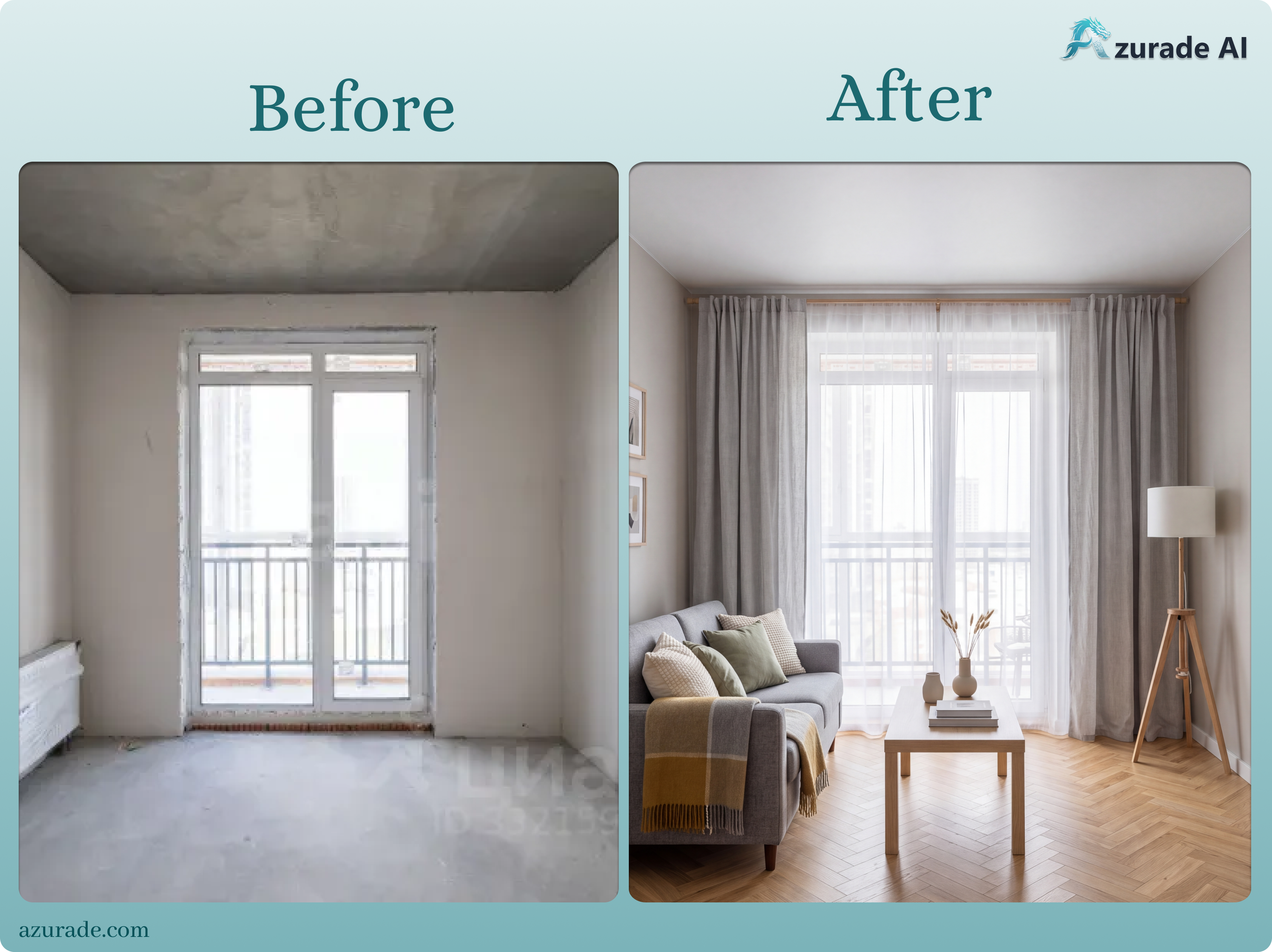
"Without changing the window layout, wall dimensions, ceiling height, or flooring, add a modern Scandinavian style to the photo, including light matte walls, light oak hardwood floors, a compact gray sofa, a wooden coffee table, minimalist decor, soft natural light streaming in from the window, and photorealism."
(Here's what we came up with using this prompt in Nano Banana 2)
-
For a family-sized Euro-style apartment:
"Without changing the layout of the windows, the size of the walls, ceiling, or floor, add a modern neoclassical style to the photo, warm beige tones, a large corner sofa, a dining table for 6 people, track lighting on the ceiling, floor-to-ceiling curtains, live plants, and natural lighting."
(Here's what we came up with using this prompt in Nano Banana 2)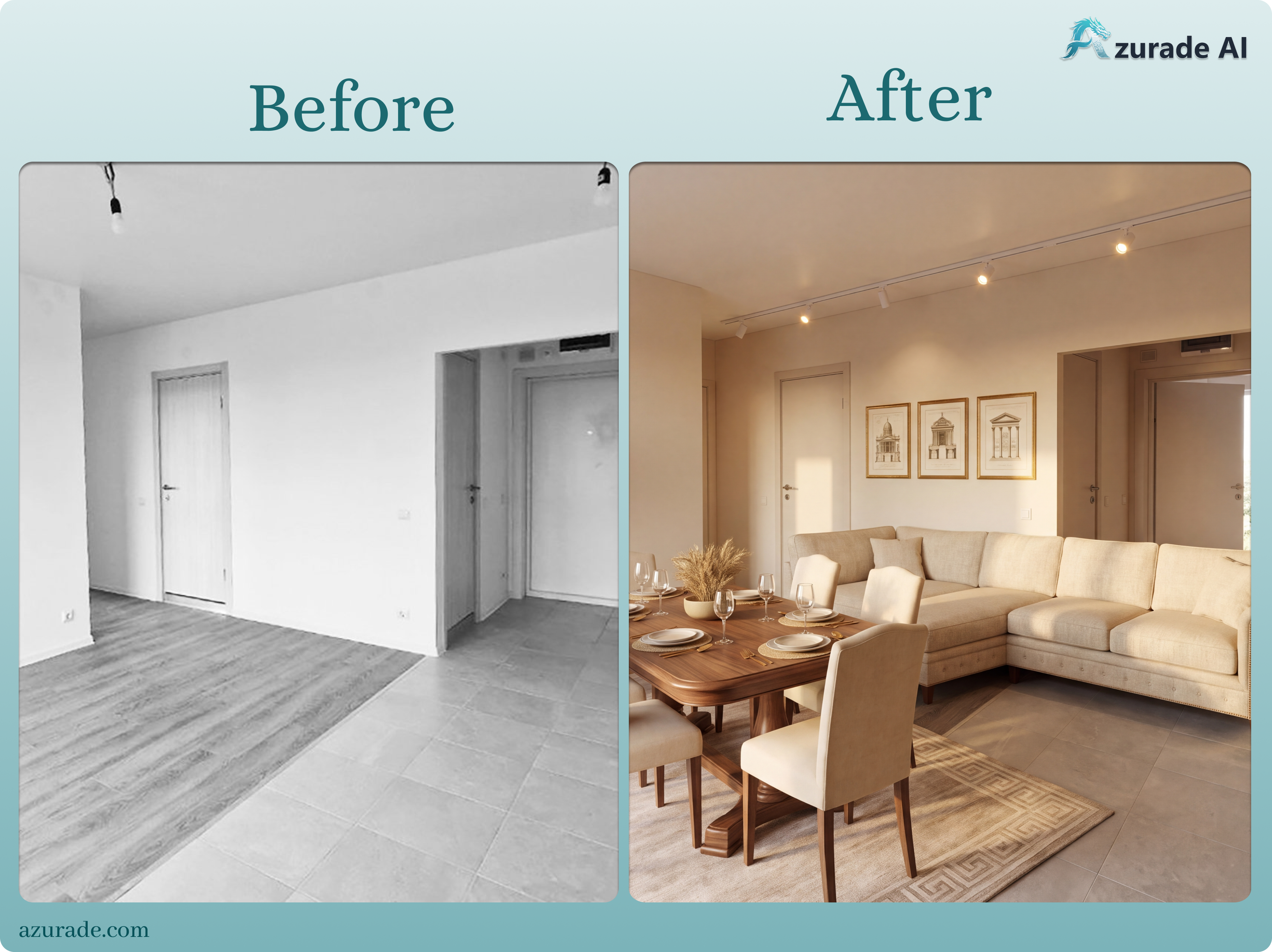
You can also change the angle, increase the resolution, or add people to the scene using special modes.
Step 3. Checking the geometry and final touches#
Generating a single image takes a few seconds. Create 2-3 variations for the key areas - the kitchen-living room and the bedroom - and check that the windows, doors, radiators, and room proportions are in the right places.
A Common Mistake: How Not to Scare Off a Client During a Viewing and Avoid Violating Platform Rules#
The main pitfall that beginners fall into when working with virtual staging is creating a gap between expectations and reality. If a buyer is drawn in by glossy designer renovations in pictures, but arrives at the viewing to find bare concrete and exposed rebar, they will feel deceived, walk out immediately, and your listing could receive a complaint for providing misleading information.
To prevent this from happening:
-
Use the "Before/After" format. Post a vivid visualization as the first image in your apartment listing feed (it will act as a click magnet), and as the second - a real photo of the same room from the same angle.
-
Add a clear disclaimer. In the corner of the rendered image, write: "Design concept / Virtual staging." This prevents any complaints from platform moderators and earns respect from buyers - you're not deceiving them, but thoughtfully presenting a vision of the future renovation.
-
Do not alter the building's structure. Never use images where the neural network has "demolished" a load-bearing wall or added a panoramic window where none exists according to the BTI plan.
Conclusion#
The real estate market has long been a visual one: buyers first "buy" the image with their eyes and only then schedule a viewing. Virtual staging removes the main barrier to selling unfinished apartments or those under renovation - the fear of empty walls. You don't need to wait for construction to finish or spend your budget on furniture to show a property in its best light.
Try uploading a couple of photos of your empty room to the Azurade real estate photo generator - the platform offers a free trial - so you can see the first version of the finished interior in just a couple of minutes.